
• Log In
 Visit the Pennsylvania State University Home Page

Research Computing and Cyberinfrastructure

  • About
    • Mission & Goals
    • Governance Structure
    • Governance Handbook
    • Membership
  • Administration
    • Advisory Council
    • Executive Committee
  • Working Groups
    • High Performance Computing
    • Onboarding
    • Research Data
    • Service and Process Coordination
  • Resources
    • Data Storage Finder
    • Research Services Catalog
  • Meetings
  • Contact

MMBIOS Workshop on Computational Biophysics

October 12, 2017 by Kaylie Maines

Original post by Tom Maiden


The following workshop to be held at the Pittsburgh Supercomputing Center this spring:

Hands-on Workshop on Computational Biophysics:Workshop Dates: May 30 – June 2, 2017

Application Deadline: May 8, 2017

For more details, or to apply visit:

http://www.mmbios.org/hands-on-workshop-on-computational-biophysics-2017


The “Hands-On Workshop on Computational Biophysics is a joint-effort between The Theoretical and Computational Biophysics Group at UIUC  and The National Center for Multiscale Modeling of Biological Systems (MMBioS). Drs. Ivet Bahar (Pitt), Emad Tajkhorshid (UIUC), and Zan Luthey-Schulten (UIUC) will lead the instruction for this interactive 4 day event.

The workshop will cover a wide range of physical models and computational approaches for the simulation of biological systems using NAMD, VMD, and ProDy. Space is limited and applications will be accepted until May 8th. This workshop is supported by MMBioS, an NIH Biomedical Technology and Research Resource (BTRR).
Filed Under: Uncategorized

SARI Credit Events for Scholars and Researchers, Fall 2017

September 11, 2017 by Kaylie Maines

SARI Credit Events for Scholars and Researchers—Fall 2017

This information is available online at www.research.psu.edu/education

No pre-registration is necessary, but come early as seminars fill up quickly. SARI Credit given for all the
workshops in this section:

  • IRB 101 Series: An Overview of Human Subject Research
    Tracie Kahler – Senior IRB Program Leader, The Office for Research Protections
    Tuesday, September 12 12:30-1:30 PM
    118 Ag Sciences & Industries Building
  • Research Misconduct: What is It and How Do I Avoid It?
    Kim Petrosky – Research Integrity Analyst, The Office for Research Protections
    Thursday, September 14 3:00-4:00 PM
    102 Kern Graduate Building
  • Research Protections: Animal, Biosafety, Isotopes & Others
    Jeremy DeRicco – ABI Program Director, The Office for Research Protections
    Thursday, September 21 11:30-12:30 PM
    102 Kern Graduate Building
  • Data Sharing and Reproducibility
    Rick Gilmore – Associate Professor of Psychology
    Thursday, September 28 12:30-1:30 PM
    102 Kern Graduate Building
  • Sponsored Award Responsibilities for Researchers
    Robin Riglin – Senior Associate Director, Office of Sponsored Programs
    Thursday, October 5 2:30-3:30 PM
    102 Kern Graduate Building
  • Peer-Reviewed Publication: Expectations of Authors & Reviewers
    Gary Messing – Distinguished Professor, Ceramic Science & Engineering
    Thursday, October 19 2:00-3:00 PM
    102 Kern Graduate Building
  • IRB 101 Series: Privacy, Confidentiality & Data Security
    Jodi Mathieu – Senior IRB Program Leader, The Office for Research Protections
    Wednesday, October 25 12:00-1:00 PM
    102 Kern Graduate Building
  • Practice Makes Perfect: Understanding & Avoiding Plagiarism
    Ellysa Cahoy – Education Librarian, Asst. Director, The Pennsylvania Center for the Book
    Wednesday, November 1 12:00-1:00 PM
    102 Kern Graduate Building
  • Laboratory Safety: Prudent Practices & Procedures for the Safe Management of Chemicals & Other Hazards in the Lab
    Robert Segura – Assistant Director, Environmental Health & Safety
    Thursday, November 2 3:00-4:00 PM
    102 Kern Graduate Building
  • Reporting Misconduct: Graduate Students’ Responsibilities, Rights, & Protections
    Timothy Balliett – University Ethics Officer, Ethics & Compliance Office
    Thursday, November 16 1:30-2:30 PM
    102 Kern Graduate Building


For the following  training, pre-registration is required. One hour of SARI credit is offered; faculty, staff, and students are welcome:

  • CATS IRB System Overview Training via Adobe Connect: (1 hr)
    This overview will introduce researchers to CATS IRB, Penn State’s online IRB submission program.

    The course will cover some preliminary information about the IRB, as well as the navigation and features of the CATS IRB system. Faculty, staff, and students are welcome. Overview will be held online via Adobe Connect.

    Fall Registration: https://cats-irb-remote-fa2017.eventbrite.com

    Session Dates:
    – September 20 9:00-10:00 AM
    – October 17 3:00-4:00 PM
    – November 13 9:00-10:00 AM
    – December 4 3:00-4:00 PM

  • CATS IRB System Overview Training-In Person: (1.5 hrs)

    This overview will introduce researchers to CATS IRB, Penn State’s online IRB submission program.

    The course will cover the basics of CATS IRB, including navigation and system features. Participants
    will practice creating a study during a hands-on portion of the course.

    Summer Registration: https://cats-irb-overview-su17.eventbrite.com

    Session Dates:
    – August – 29 2:00-3:30 PM

    Fall Registration: https://cats-irb-fa2017.eventbrite.com

    Session Dates:
    – September 26 2:00-3:30 PM
    – October 24 9:00-10:30 AM
    – November 9 2:00-3:30 PM


Filed Under: Uncategorized

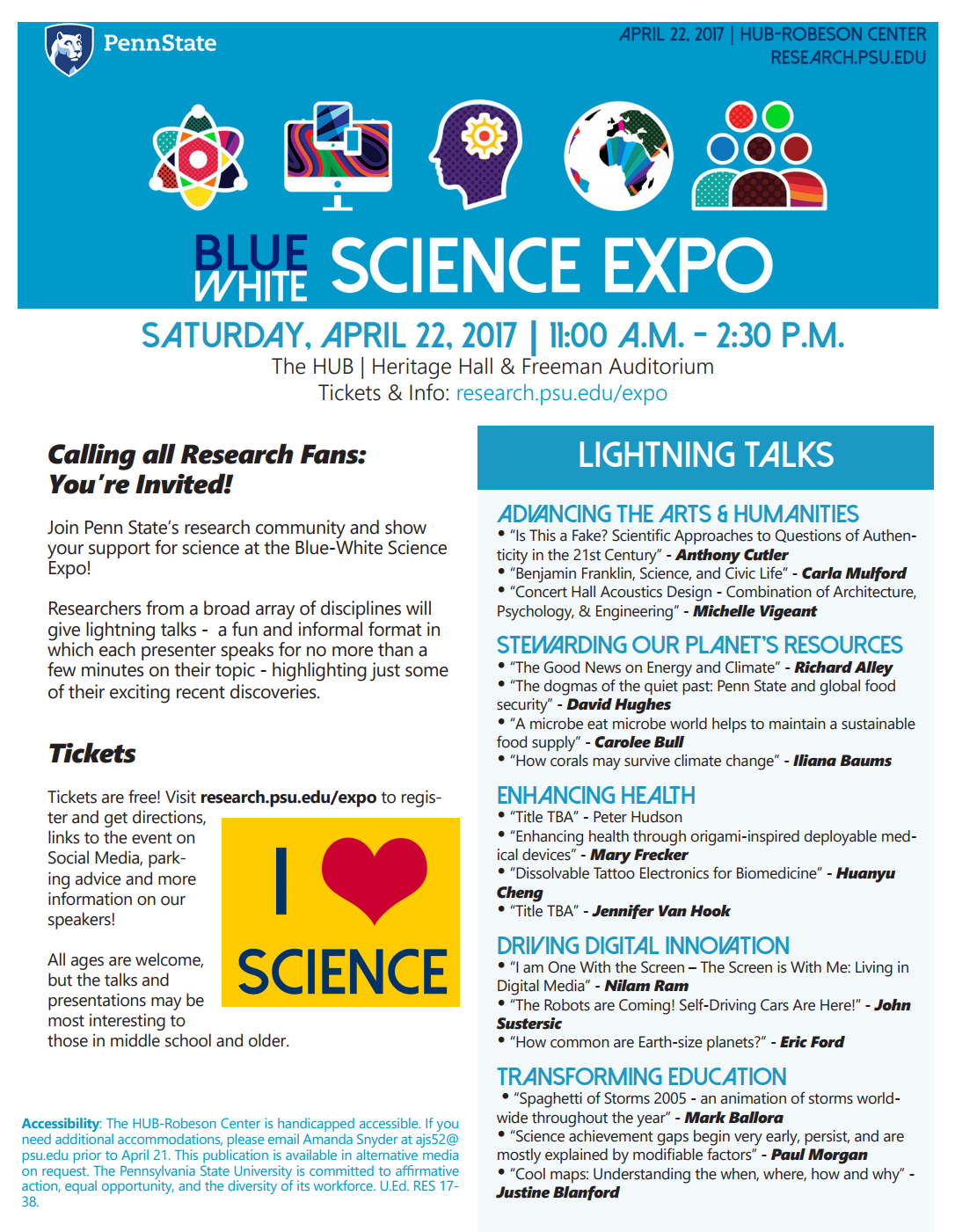
Science Expo

April 5, 2017 by Kaylie Maines

Filed Under: Uncategorized

Computational Techniques for Life Sciences

March 7, 2017 by Kaylie Maines

Original post by Jason Allison

June 5-9, 2017

The Computational Techniques for Life Sciences Institute is a five day immersive training event for researchers in the life sciences. Participants will learn the basic skills necessary to develop and execute life sciences workflows on large-scale systems, run parallel analyses, use Bash and Python to chain common life sciences applications together to form more complex workflows, and analyze result data in order to gain useful insights.

TACC’s Life Sciences Computing team members will also spend time one-on-one with participants discussing how to accelerate their existing research or how to start a new project by beginning with the best computational practices.

Please visit the following link for details and to register: https://www.tacc.utexas.edu/education/institutes/computational-techniques-for-life-sciences

Filed Under: Uncategorized

Security Strategy Presentation by Don Welch

March 1, 2017 by Kaylie Maines

This is an open invitation to any interested parties to attend Security Strategy Ideas for Penn State by Don Welch, CISO on Thursday, April 20, 2017 from 10 – 11 AM.

The talk will take place at:
Liberal Arts IT Office – Greenleaf Park One
2013 Sandy Drive, Suite 201

Parking is available.

Please feel free to invite other interested colleagues!

RSVP to jlp49@psu.edu by April 18, 2017

Filed Under: Uncategorized

PEARC17 Conference Registration Now Open

February 21, 2017 by Kaylie Maines

Original post by Travis Tate 

New Orleans hosting national conference for advanced research computing professionals and students!

Registration is now open for the first annual PEARC conference! PEARC17 is open to professionals and students in advanced research computing. The conference will take place July 9-13 at the Hyatt Regency New Orleans (601 Loyola Ave., New Orleans). Registrants can book their conference registration and hotel room at www.pearc.org

The PEARC (Practice & Experience in Advanced Research Computing) conference series is being ushered in with support from many organizations, and will build upon earlier conferences’ success and core audiences to serve the broader community. In addition to XSEDE, organizations supporting the new conference include the Advancing Research Computing on Campuses: Best Practices Workshop (ARCC), the Science Gateways Community Institute (SGCI), the Campus Research Computing Consortium (CaRC), the ACI-REF consortium, the Blue Waters project, ESnet, Open Science Grid, Compute Canada, the EGI Foundation, the Coalition for Academic Scientific Computation (CASC), and Internet2.


Registration costs are as listed below:

Regular Registration: $500 (Tues – Thurs)

Late Registration Fee: $600 (as of 5 p.m. ET 5/31/17)

Student Registration: $300 Note: must provide ID upon check-in for the conference

Student Registration: $360 Note: must provide ID upon check-in for the conference (as of 5 p.m. ET 5/31/17)

Tutorial Fee: $125 (Monday only)

Late Tutorial Fee: $150 (as of 5 p.m. ET 5/31/17)

Student Tutorial Fee: $80 (Monday only)

Late Student Tutorial Fee: $95 (as of 5 p.m. ET 5/31/17)

One Day Registration: $200

Late One Day: $240 (as of 5 p.m. ET 5/31/17)

Two Day Registration: $400

Late Two Day: $480 (as of 5 p.m. ET 5/31/17)


The Call for Participation is also open and accepting submissions from now until March 6 for Technical Papers and Tutorials. External Program and Workshop proposals are due March 31. Poster, Visualization Showcase and Birds-of-a-Feather submissions are due May 1.

Filed Under: Uncategorized

Blue Waters Launches a Weekly Webinar Series

February 17, 2017 by Kaylie Maines

Original post by Travis Tate

The series starts Wednesday, March 1

The National Center for Supercomputing Applications (NCSA) at the University of Illinois at Urbana-Champaign is pleased to announce the Blue Waters Weekly Webinar Series. The series will provide the research and education communities with a variety of opportunities to learn about methods, tools, and resources available to advance their computational and data analytics skills, with an emphasis on scaling to petascale and beyond.

Webinars will generally occur every Wednesday, with a few exceptions to avoid conflicts with major HPC conferences and events. All sessions will be free and open to the to everyone who registers. Registered participants will be able to pose questions using NCSA’s Blue Waters Slack environment. “Registration”:https://bluewaters.ncsa.illinois.edu/webinars/registration is required for access to YouTube Live broadcasts. Webinars will begin at 10 a.m. Central Time (UTC-6).

Each webinar will be led by a developer or an expert on the topic. The first visualization webinar, “Introduction to Data Visualization” hosted by Vetria Byrd, Purdue University, will take place on March 1, 2017; the first workflows webinar, “Overview of Scientific Workflows” will be hosted by Scott Callaghan, University of Southern California, on March 8, 2017; and the first petascale application improvement discovery webinar, “Getting I/O Done with Parallel HDF5 on Blue Waters” hosted by Gerd Heber, HDF Group, will take place March 29, 2017. The list of webinar tracks as well as specific sessions will be refined and expanded over time.

For more information about the webinar series, including registration, abstracts, speakers, as well as links to Youtube recordings, please visit the Blue Waters webinar series webpage.


About Blue Waters:

Blue Waters, managed by the National Center for Supercomputing Applications, is one of the most powerful supercomputers in the world. It can complete more than 1 quadrillion calculations per second on a sustained basis and more than 13 times that at peak speed. Blue Waters is the fastest supercomputer at a university anywhere in the world. Blue Waters also collaborates with other national HPC programs to prepare current and future faculty and both undergraduate and graduate students to gain the knowledge and skill sets necessary to capitalize on high-performance computing resources. Activities include training and workshops for faculty and students, campus visits, undergraduate internship, and graduate fellowships. Blue Waters is supported by the University of Illinois and the National Science Foundation through awards ACI-0725070 and ACI-1238993.


About NCSA:

The National Center for Supercomputing Applications (NCSA) at the University of Illinois at Urbana-Champaign provides supercomputing and advanced digital resources for the nation’s science enterprise. At NCSA, University of Illinois faculty, staff, students, and collaborators from around the globe use advanced digital resources to address research grand challenges for the benefit of science and society. NCSA has been advancing one third of the Fortune 50 for more than 30 years by bringing industry, researchers, and students together to solve grand challenges at rapid speed and scale.

Filed Under: Uncategorized

Livestream Link: NE BD Hub Annual Workshop

February 16, 2017 by Kaylie Maines

Livestream Link: 2017 Annual Workshop of the
Northeast Big Data Innovation Hub
Starting at 8:55 am ET on 2/24/17, you’ll be able to join our Annual Workshop via livestream at the following link. Please share with colleagues who may wish to participate but are unable to join us in New York.
http://tinyurl.com/NEBDHub-022417-livestream
For further information on our event, and to register to attend in person, see below. We hope to see you there! Follow us on Twitter @NEBigDataHub and use #NEBigData & #BDHubs to tweet about this event.
Register via Eventbrite
(required)Please see below for our current agenda.
The most up-to-date version, as well as additional event information,
may be found on our event page.

Friday, February 24th, 2017

8 – 9 am: Welcome Reception

9 – 9:10 am: Welcome & Opening Remarks – Kathleen R. McKeown, Henry and Gertrude Rothschild Professor of Computer Science, Columbia University

9:10 – 9:30 am: State of the Hub – René Bastón, Executive Director, Northeast Big Data Innovation Hub

9:30 – 10:15 am: Northeast Spoke Lightning Talks

  • Health: Chirag Patel, Harvard Medical School
  • Data Sharing: Carsten Binnig, Brown University
  • Education: Beverly Woolf, University of Massachusetts Amherst

10:15 – 10:30: Coffee Break

10:35 – 11:35: Northeast Planning Project Lightning Talks

  • Privacy & Security: Rebecca Wright, Rutgers University
  • Privacy & Security: John Yen, Penn State
  • Energy: Abani Patra, University at Buffalo, SUNY
  • Data Literacy: Stephen Uzzo and Catherine Cramer, New York Hall of Science

11:40 – 12:10: Presentation by the National Science Foundation

12:10 – 1:10: Lunch

1:15 – 2:00: Fireside Chat:  Industry Perspectives on Data Science and Collaborations

  • Eric Brown, Director, Foundational Innovation, IBM Watson Health
  • Chris Wiggins, Chief Data Scientist, The New York Times
  • Rachel Lomasky, Director of Analytics, WEVO Conversion
  • Moderated by Carla Brodley, Dean, College of Computer and Information Science, Northeastern University

2:15 – 3:45: Breakout Sessions

  • Cross Fertilization among Priority Areas
  • Partnerships of the Northeast Hub
  • Resources for the Northeast Community

4:00 – 5:00: Breakout Presentations & Next Steps

5:00 – 5:15 Closing Remarks

5:30 – 7:00: Happy Hour Reception

Questions? Reach out to us at contact@nebigdatahub.org.

Filed Under: Uncategorized

Centralized Application Tracking System (CATS) Training to be offered [ Spring 2017 Schedule ]

December 7, 2016 by Kaylie Maines

The CATS IRB system simplifies the process and replaces the PRAMS system; it is a newer electronic Centralized Application Tracking System (CATS) for Instructional Review Board (IRB) submissions. Researchers who are required to submit to the IRB must use this system to submit their IRB protocol and manage their study. There are various components to the system, including protocol smartforms, templates, checklists and video tutorials. More information regarding the CATS IRB implementation and the PRAMS to CATS conversion can be found on the CATS home page at irb.psu.edu.

The summer training sessions will introduce researchers to CATS IRB, Penn State’s new online IRB submission program, as well as cover the basics of CATS IRB, including navigation and system features. Faculty, staff, and students are welcome.

Participants will learn:

  1. How to navigate the CATS IRB system
  2. Features of CATS IRB and differences from PRAMS
  3. How to create a new study submission

The in-person objectives are the same as the above Adobe Connect outline, with the exception that participants will also have the opportunity to practice creating and modifying a study during the hands-on portion of the in-person course.

The summer training schedule is listed below.

Registration for in-person classroom session: https://www.eventbrite.com/e/spring-2017-adobe-connect-cats-irb-system-overview-registration-30055576037

  • January 25th from 2:00 – 3:30
  • February 22nd from 2:00 – 3:30
  • March 20th from 9:30 – 10:30

Adobe Connect registration: https://www.eventbrite.com/e/spring-2017-adobe-connect-cats-irb-system-overview-registration-30055576037 

  • January 16th from 2:30 – 3:30
  • February 16th from 3:00 – 4:00
  • March 17th from 9:00 – 10:00

Filed Under: Uncategorized

The Great Lakes Consortium for Petascale Computation: Blue Waters Project

November 30, 2016 by Kaylie Maines

DEADLINE: Midnight EST, December 2, 2016


The Great Lakes Consortium for Petascale Computation (GLCPC) has been allocated 3.5 million node hours (equivalent to approximately 50 million core hours) annually as part of the Blue Waters project. This allocation provides the GLCPC member institutions with an unprecedented opportunity to advance their programs in computation, data, and visualization intensive research and education. This Call For Proposals (CFP) describes the process for submitting a proposal to the GLCPC Allocations Committee for allocations on the Blue Waters system. Details on the Blue Waters system can be found at https://bluewaters.ncsa.illinois.edu/blue-waters and http://www.ncsa.illinois.edu/enabling/bluewaters.


The GLCPC is seeking innovative proposals that fall into four categories:

  1. Scaling studies: The scaling of codes which will operate efficiently on large numbers of parallel processors presents a number of challenges. Therefore, projects of particular interest include those that optimize and/or scale community codes to very large scales. Examples include scaling of multilevel parallel applications (MPI+OpenMP), accelerators (CUDA, OpenACC or OpenCL), I/O and data-intensive applications, or novel communication topologies.
  2. Multi-GLCPC-institutional projects addressing focused scientific projects. An example might be a Great Lakes Ecosystems Modeling initiative (Digital Great Lakes).
  3. Proposals for applications well-suited for the Blue Waters system architecture.
  4. Proposals from non-traditional and underserved communities.


Full details of the CFP can be found at http://www.greatlakesconsortium.org/2016cfp.html.


The GLCPC Allocations Committee anticipates 3-8 projects/allocations annually of ~50 million core hours, and is especially interested in researchers who can scale to several thousand cores or take advantage of parallel-GPU resources.


PIs are encouraged to submit proposals in Category 1 (Scaling Studies), which could reuse text from previous proposals.


Filed Under: Uncategorized

  • 1
  • 2
  • Next Page »
 Visit the Pennsylvania State University Home Page
Copyright 2025 © The Pennsylvania State University Privacy Non-Discrimination Equal Opportunity Accessibility Legal

Copyright © 2025 · Genesis for PSU on Genesis Framework · WordPress · Log in